
Technical catalogs
Categories, product families and meaningful filters built from actual attributes, with exact variants that buyers can compare.
Expertise / B2B e-commerce
B2B platforms, product catalogs and custom e-commerce that connect how buyers choose with how your business prices, supplies and fulfils.
Discuss your catalog01 / Expertise
Technical variants, customer-specific rules and quote-led purchasing change how a store should work. We design the product model and buying journey together, whether the result is an order, a specification or a request for a commercial offer.
Categories, product families and meaningful filters built from actual attributes, with exact variants that buyers can compare.
Specification lists, quote requests, customer accounts and approval steps shaped around the way your buyers purchase.
Plan CRM, ERP, PIM or BAS integrations around data ownership, update rules and recoverable failures.
02 / B2B e-commerce
Start with real catalog samples. Decide which attributes define a family, which distinguish a variant and which help a buyer choose. Preserve those facts through the commercial handoff.
Choose the authoritative system for products, prices and availability. Define update frequency, conflict handling and recovery before automating imports.
Plan indexable pages, filter URL rules, localized metadata and structured data together. Measure search performance after launch against a defined baseline.
Map old URLs, rehearse data transfers and verify redirects, buyer flows and rollback. Include performance checks on representative catalog pages.
03 / See it in practice
B2B catalog · Product data · SEO
Different steel products require different selection criteria. We connected the filters to product data so buyers can narrow the selection using relevant characteristics. They can compare variants in a table or switch to cards, keeping product specifications in view.
Webfox’s role: Catalog architecture, interface design and development
Explore the case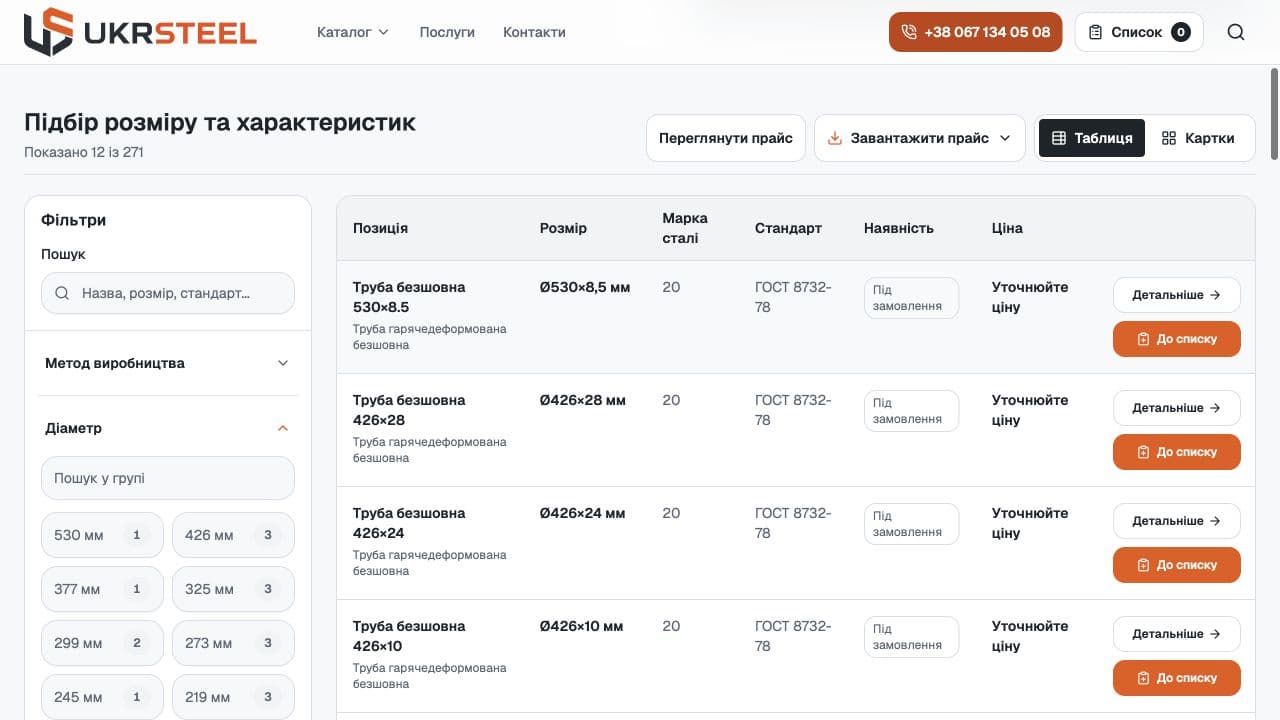
04 / WEBFOX
Inspect catalog samples, buyer tasks, current systems and migration constraints.
Prototype families, filters and the order or quote journey using real products.
Build the interface, editorial tools and agreed integrations in working increments.
Rehearse migration, check search and purchase paths, and hand over operating guidance.
A large, consistent catalog can be simpler than a small one with customer-specific pricing and difficult source data. We estimate from the product model, integrations, buyer roles, migration needs and first-release scope. A standard storefront may be sufficient when those requirements are simple.
Yes. A specification can retain the exact items, quantities and units, then become one enquiry. Checkout and quote flows can be scoped separately.
We model shared families and variant-defining attributes from real data, then test filters and comparison with representative buyer tasks.
We first review the system interfaces and commercial rules. The integration scope specifies data ownership, updates and what buyers see when information is stale.
Inventory current URLs and data, define mappings and redirects, rehearse the transfer and compare crawl results. Search rankings cannot be guaranteed; migration risks can be identified and monitored.
Your team works through the agreed CMS or product system. We define editable fields, import ownership and maintenance tasks, then provide handover guidance.
The estimate depends on catalog rules, integrations, account features and migration. A data and workflow review lets us propose a useful first release and its budget.
Contact
Tell us about your assortment, current systems and buying process. With a sample catalog, we can identify the product model, integration dependencies and a practical first release.
hello@webfox.net.ua +380 67 985 95 59